What Is Total Impulse and Why Does It Matter?
Total impulse is the fundamental measurement that defines every rocket motor classification. It's measured in Newton-seconds (Ns) and represents the total force delivered over the motor's entire burn time. A motor that produces 5 Newtons of thrust for 1 second has a total impulse of 5 Ns. A motor that produces 10 Newtons for 0.5 seconds also has a total impulse of 5 Ns. The letter classification tells you the range of total impulse, not the peak thrust or burn time alone.
This matters for several practical reasons. First, total impulse determines how high and fast your rocket will fly — more impulse means more energy to work with. Second, total impulse determines which FAA classification your rocket falls into, which dictates whether you need any kind of authorization to fly. Third, total impulse above certain thresholds requires NAR or Tripoli certification to purchase and use. Understanding the system from the bottom up is essential before you buy any motor.
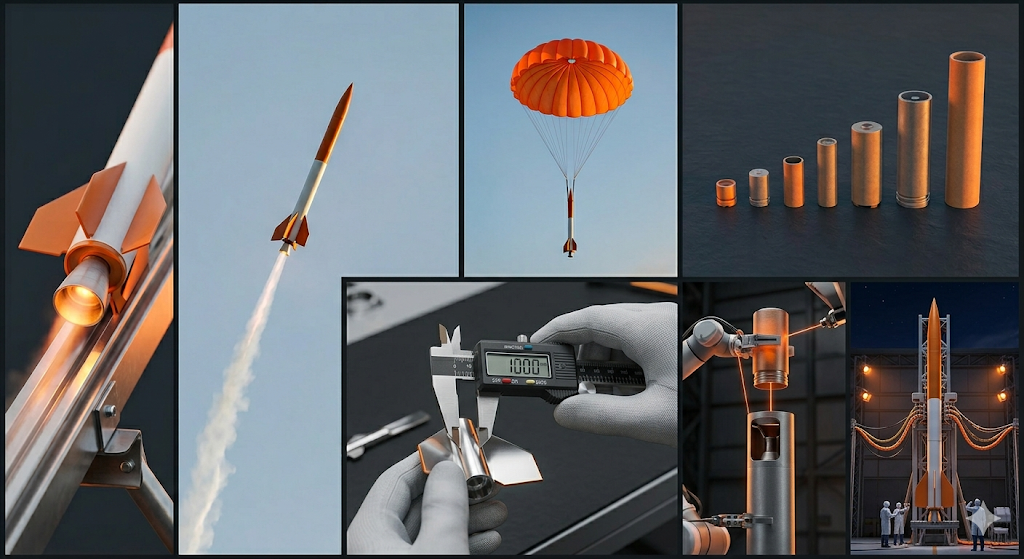
The Complete Motor Classification Chart
The following table covers every standardized motor class recognized by the NAR and Tripoli Rocketry Association, from the smallest model rocket motor to the giant research motors that can push 50-pound rockets to 30,000 feet.
| Class | Total Impulse Range | FAA Class | Cert Required | Purchase Notes | Typical Use |
|---|---|---|---|---|---|
| A | 1.26 – 2.50 Ns | Class 1 | None | Over-the-counter, no ID | Starter rockets, indoor flying |
| B | 2.51 – 5.00 Ns | Class 1 | None | Over-the-counter, no ID | Light beginner kits, 200–400 ft altitude |
| C | 5.01 – 10.00 Ns | Class 1 | None | Over-the-counter, no ID | Standard Estes kits, 400–800 ft |
| D | 10.01 – 20.00 Ns | Class 1 | None | Over-the-counter, 18+ in some states | Mid-power starters, 800–1,500 ft |
| E | 20.01 – 40.00 Ns | Class 1 | None | Hobby shop or online; 18+ required | Mid-power entry, 1,000–2,500 ft |
| F | 40.01 – 80.00 Ns | Class 1 | None | Certified dealer; must be 18+ | Mid-power, 1,500–4,000 ft |
| G | 80.01 – 160.00 Ns | Class 1* | None (some G motors require cert) | Certified dealer; must be 18+ | High mid-power, 2,000–5,000 ft |
| H | 160.01 – 320.00 Ns | Class 2 | Level 1 HPR | Level 1 cert card required at purchase | High Power entry, 2,000–6,000 ft |
| I | 320.01 – 640.00 Ns | Class 2 | Level 1 HPR | Level 1 cert card required | HPR standard, 3,000–8,000 ft |
| J | 640.01 – 1,280.00 Ns | Class 2 | Level 2 HPR | Level 2 cert required | Advanced HPR, 5,000–15,000 ft |
| K | 1,280.01 – 2,560.00 Ns | Class 2 | Level 2 HPR | Level 2 cert required | Advanced HPR, 10,000–25,000 ft |
| L | 2,560.01 – 5,120.00 Ns | Class 2 | Level 2 HPR | Level 2 cert required | Competition HPR, 15,000–35,000 ft |
| M | 5,120.01 – 10,240.00 Ns | Class 2 | Level 3 HPR | Level 3 cert, CSFM in CA | Altitude records, 25,000–50,000 ft |
| N | 10,240.01 – 20,480.00 Ns | Class 2 | Level 3 HPR | Level 3 cert, ATF oversight may apply | Experimental, 40,000+ ft |
| O | 20,480.01 – 40,960.00 Ns | Class 2 | Level 3 HPR | Research only; ATF LEUP may be required | Advanced research, near-space attempts |
* Some G motors with average thrust >80 N are classified as HPR motors under NFPA 1127 despite falling in the Class 1 impulse range. Always check the specific motor's NFPA classification with the manufacturer.
How to Read a Motor Code
When you pick up an Estes or AeroTech motor, the label contains a standardized code that tells you everything you need to know. Take the motor code C6-5 as an example. Each part of that code has a specific meaning:
C6-5 decoded:
C = Total impulse class (5.01–10.00 Ns in this case)
6 = Average thrust in Newtons (how hard it pushes throughout the burn)
5 = Delay in seconds between motor burnout and ejection charge firing (which deploys your recovery system)
So a C6-5 motor delivers C-class impulse at 6 Newtons average thrust, with a 5-second delay before ejection. A C6-3 has the same thrust but a shorter delay — better for a faster-rising rocket.
Delay Code Variations
The delay number is one of the most critical choices you'll make when selecting a motor. Too long a delay and your rocket is already falling before the parachute deploys — risking a "ballistic recovery" where the chute never opens fully. Too short and the chute opens at max altitude when the rocket is still moving fast, which can tear the recovery system. Common delay options:
- 0-delay (e.g., C6-0): No delay — designed for use as a booster stage in multi-stage rockets, not for single-stage recovery
- 3-second delay: For fast-climbing, heavier rockets that reach apogee quickly
- 5-second delay: Standard for most beginner kits — assumes a moderate climb rate
- 7-second delay: For lighter rockets that coast longer before reaching apogee
The Critical FAA Threshold: Class 1 vs. Class 2
The most important regulatory line in the motor classification system is the transition from Class 1 to Class 2 rockets under federal law. Under 14 CFR Part 101, a rocket becomes a Class 2 rocket — and therefore requires an FAA Certificate of Waiver or Authorization to fly — when it crosses any of these thresholds:
- Uses a motor (or combination of motors) with more than 160 Ns total impulse — this means H motors and above always require a waiver
- Weighs more than 1,500 grams (3.3 lbs) at launch, regardless of motor size
- Contains more than 125 grams (4.4 oz) of propellant in all motors combined
- Has an average thrust greater than 80 Newtons — some high-thrust G motors can trip this threshold
The practical takeaway: H motors and above require a FAA waiver to fly legally. This doesn't mean you need to file the waiver yourself — you need to fly at a club field that has an active COA covering that impulse range. Most established NAR sections maintain annual waivers for their regular launch fields. See our FAA COA Waiver walkthrough for how those waivers work.
When Certification Is Required to Buy Motors
The National Association of Rocketry and Tripoli Rocketry Association have established certification requirements that are enforced at the point of purchase by certified dealers. If you walk into a rocketry dealer and ask for an H motor without showing your Level 1 certification card, they are required to refuse the sale.
Here's the practical certification-to-motor matrix:
- No certification required: A through G motors (with some G exceptions as noted above)
- Level 1 HPR certification: Required to purchase and use H and I class motors
- Level 2 HPR certification: Required for J, K, and L class motors
- Level 3 HPR certification: Required for M, N, and O class motors
This certification system is enforced by the dealer network and by range safety officers at club launches. Attempting to fly a motor above your certification level will get you grounded at any NAR or Tripoli event, and potentially removed from the club. The certification system exists because higher-impulse motors are genuinely more dangerous — they require more sophisticated rockets, recovery systems, and situational awareness to fly safely.
Where to Buy Motors and Age Restrictions
Model rocket motors are classified as "pyrotechnic devices" under federal law, which creates specific age restrictions and purchase channels. Here's what you need to know:
A–D Motors
A through D motors (low-power) are sold at hobby shops, Walmart, Target, and online. Federal law sets no minimum age for purchase, but many retailers have internal 18+ policies. These motors are sold as a complete unit (motor, propellant, and delay element) and are not individually regulated as explosives at the federal level when sold in packaged form.
E–G Motors (Mid-Power)
E through G motors must be sold through a licensed pyrotechnic dealer. You must be at least 18 years old to purchase. These motors require no certification card, but reputable online dealers like AeroTech, Apogee Components, and Wildman Rocketry will ask for age verification. Many of these motors use composite propellant (APCP — Ammonium Perchlorate Composite Propellant) which the ATF once classified as an explosive but now recognizes as an exempt consumer product when sold as a complete motor assembly.
H and Above (High Power)
H and above require an NAR or Tripoli certification card for purchase. You must also be 18+. Large motors (above approximately 62.5 grams of propellant) are technically regulated as low explosives by the ATF, meaning dealers must be licensed to sell them and maintain purchase records. At the largest end of the scale (N and O motors), individual hobbyists typically need to make motors themselves through a research certification program, as commercial availability is extremely limited.
Ready to fly? Browse the most popular low-power Estes motors on Amazon. A, B, C, and D class motors are available without any certification — ideal for backyard and park launches with the rockets described throughout this guide.
Browse Motors on Amazon →As an Amazon Associate, Rocketry Clearance earns from qualifying purchases.
Use Our Motor Selector Tool
Rather than manually working through the chart above, use our interactive Motor Class Selector Tool. Enter your rocket's estimated launch weight and desired altitude — the tool returns the appropriate motor class range, FAA classification, certification requirement, and minimum field size based on NFPA 1122 guidelines.
Remember the doubling rule: Each letter class has exactly double the impulse ceiling of the previous one. An E motor carries at most 40 Ns. An F motor carries at most 80 Ns. This means skipping two classes (e.g., going from D to F) delivers up to 4x the total energy. Plan your rocket's weight, stability, and recovery system accordingly — the rocket that flies great on a C motor may be completely unstable on an E motor if the fins and weight aren't scaled appropriately.