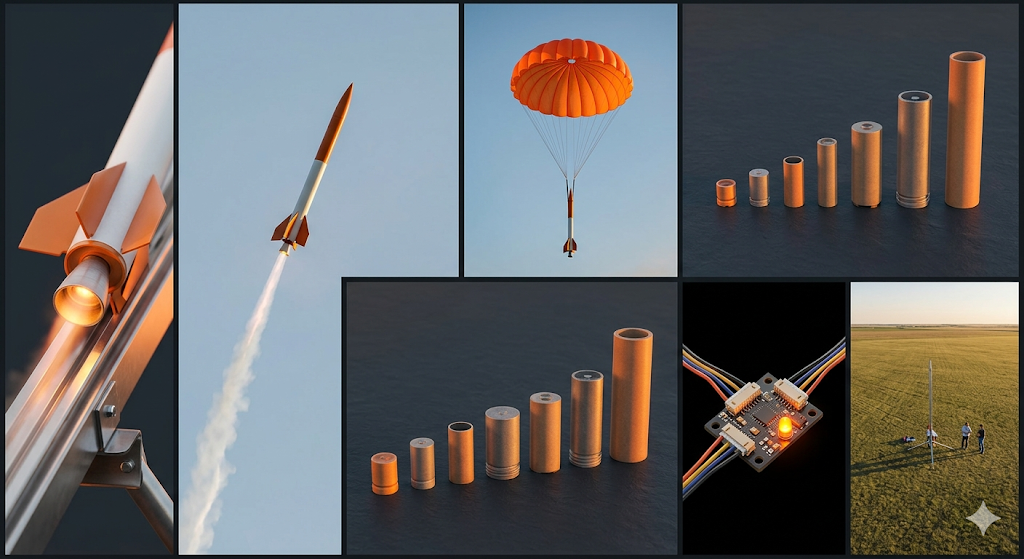
What Model Rocketry Actually Is
Model rocketry is the hobby of building, flying, and recovering small to medium-sized rockets powered by commercially manufactured solid-fuel motors. Unlike fireworks or pyrotechnics, model rockets are designed to fly straight up, deploy a recovery device (usually a parachute or streamer), and land safely for reuse. The rockets are the product of engineering — stability, center of gravity, motor selection, and recovery system design all play roles in whether a rocket flies beautifully or becomes an embarrassing crater.
The hobby has been organized in the United States since 1957, the year the National Association of Rocketry was founded. In the decades since, the hobby has expanded from simple paper-tube Estes kits to sophisticated fiberglass and carbon fiber rockets flying on motors as powerful as small amateur jet engines. But it has never lost its essential accessibility — a first-time builder with a $30 kit and $8 in motors can have a genuinely exciting, safe, and legal launch experience on a weekend afternoon.
There are two main tiers of the hobby: low-power rocketry (motors A through G, no certification required) and high-power rocketry (motors H and above, certification from NAR or Tripoli required). Most beginners start in low-power and transition to high-power as they gain experience and interest. Many hobbyists are completely happy spending their entire time in the low-power tier — the flights are still spectacular and the complexity ceiling is as high as you want to push it.
What You Actually Need to Get Started
The barrier to entry is low. Here's the minimum equipment for a beginner's first launch:
The Rocket
Your first rocket should be a Ready-to-Fly (RTF) or Almost-Ready-to-Fly (ARTF) kit rather than a build-from-scratch kit. RTF rockets come pre-assembled and only need motor installation. ARTF kits require some light assembly (fin alignment, nose cone connection) but no major construction. Good first rockets for adults include the Estes Alpha III RTF, the Estes Big Bertha ARTF, and the Estes Crossfire ISX. These are widely available at hobby shops and online for $15–$45.
Avoid starting with a two-stage or cluster rocket, a rocket that requires dual-deployment recovery, or any kit rated "skill level 4 or 5." Those are second or third rocket projects, not first ones. Build your skills with a simple, single-motor, streamer or parachute recovery rocket first.
The Launch System
You need a launch pad and launch controller. Most beginner kits come bundled with an Estes launch set that includes both. If you're buying a standalone rocket, look for the Estes Pro Series II launch set or similar. The launch system includes an electrical ignition controller (the "launch controller"), a launch rod to guide the rocket in its initial flight, and an electrical igniter clip system. Never ignite a model rocket motor by any means other than an electrical launch controller — the motor ignites instantly and there is no safe distance for a hand-lit rocket.
Motors
Your kit's instructions will specify which motor sizes are compatible. Start with the smallest motor in the recommended range. An Estes Alpha on a C6-5 motor is a joy to watch and reaches about 400 feet — plenty exciting. You can always go bigger once you understand how the rocket behaves on smaller motors. See our complete Motor Classification Guide to understand what the letters and numbers on motor labels mean.
Launch Site
You need a flat open area with no overhead obstructions. Grass is ideal — concrete and pavement are hard on recovery systems and rockets that drift. The minimum recommended open area for A–C motors is about 50 feet in all directions from the launch pad. D motors need 100 feet. Wind is your enemy: if wind is above 15 mph, postpone. Your rocket will drift downwind on recovery and you'll spend more time searching for it than flying it. Read our guide on backyard launch rules to ensure your chosen site is legal.
The most recommended starter setup for adult beginners — includes a proven RTF rocket, launch pad, launch controller, and everything you need to fly on your first day. This is the exact setup we walk through in this guide. Available directly on Amazon.
View on Amazon →As an Amazon Associate, Rocketry Clearance earns from qualifying purchases.
What to Expect on Launch Day
Here's the real-world sequence of a typical beginner's first launch, stripped of jargon:
- Prepare your rocket on the ground.
Install the recovery wadding (fireproof paper squares that go in before the parachute, protecting it from ejection charge gases). Install the parachute or streamer by folding it loosely. Attach the shock cord. Slide the nose cone on and make sure it fits snugly but will eject when pressure is applied.
- Install the motor.
Slide the motor into the motor mount tube in the rocket's base. Install the igniter (the thin wire element that sits inside the motor nozzle). Some motors have igniters pre-installed. Make sure the igniter leads are visible below the rocket base — you'll clip the launch controller alligator clips to them.
- Set up the launch pad.
Extend the launch rod, adjust it to near-vertical (a very slight upwind lean of 1–3 degrees is common practice to compensate for wind drift). Place the blast deflector beneath the rod's base to protect the ground and deflect the motor exhaust safely.
- Slide the rocket onto the launch rod.
The launch lug (a small plastic ring on the rocket's body) slides over the rod. Push the rocket down until it rests on the blast deflector or rod support. Connect the alligator clips to the igniter leads.
- Clear the launch area.
Everyone moves back from the launch pad. NFPA 1122 specifies minimum safety distances — for an A–B motor launch, all observers should be at least 15 feet away. For C–D motors, 30 feet. Clear the area completely before arming the controller.
- Arm the launch controller and count down.
Insert the safety key into the launch controller to arm it. Do a verbal countdown: "5-4-3-2-1-Launch." Press the button. The igniter fires, the motor ignites, and the rocket accelerates from 0 to 50–100+ mph in about 0.3 seconds. You'll hear a sharp crack and see a trail of smoke as it climbs.
- Watch the flight and recovery.
The motor burns for 0.5–2 seconds depending on class. Then there's a coasting phase where the rocket climbs on momentum. At apogee (peak altitude), the ejection charge fires — you'll see a small puff of smoke — and the parachute or streamer deploys. Track the rocket as it drifts downwind and note where it lands. Go retrieve it.
The Mistakes Beginners Make (And How to Avoid Them)
Most first-launch failures aren't hardware failures — they're procedural. Here are the most common issues and how to preempt them:
Wrong Motor for the Conditions
Using too powerful a motor on a light rocket leads to unstable or overly fast flights. Using too small a motor on a heavy rocket leads to insufficient velocity to achieve stable flight. Always follow the kit's recommended motor range. If flying outdoors in wind, go with a slightly smaller motor than maximum — a lower, slower flight is easier to recover than a fast one that drifts half a mile downwind.
Parachute Not Folding Correctly
A tangled or too-tightly-packed parachute won't deploy fully, and the rocket will fall faster than intended. Fold the chute loosely and use only the amount of recovery wadding the instructions recommend. Test the parachute deployment by hand before first flight — push the nose cone on, then blow gently into the motor tube. The nose cone should pop off cleanly and the chute should unfold.
Igniter Not Fully Seated
If the igniter isn't seated inside the motor nozzle's propellant charge, it won't ignite the motor. The controller will click, nothing will happen, and you'll have a misfire. After connecting the alligator clips, gently confirm the igniter leads are taut — they should be connected to the controller clips and have no slack. If you have a misfire, wait 60 seconds before approaching the rocket. Remove the safety key from the controller first.
Why Joining a Club Changes Everything
Solo backyard launches are fine for beginners with A–C motors and a suitable yard. But the hobby gets dramatically better when you connect with a local rocketry club. Club launches provide range officers who help troubleshoot problems, experienced mentors who have seen every failure mode, much larger fields where you can fly bigger rockets, and the social element that makes the hobby stick long-term.
Find your nearest NAR section using the section finder at nar.org. Attend a launch as a spectator before joining — everyone in the hobby was once a beginner and clubs are almost universally welcoming to newcomers. Read our launch site finder guide for how to locate and evaluate clubs near you.
The honest timeline: First flight to confident low-power launcher takes about 5–10 flights spread over a few weeks. Low-power to Level 1 HPR certification takes most people 6–18 months. The hobby rewards patience and observation — every flight teaches you something about what worked and what to improve.